A graph database in Common Lisp.
Scalaxy is a Common Lisp graph database. Query property graphs with openCypher, inspect data in the HTTP console, and replicate writes across nodes from the same binary.
# run the test suite (9,018 checks)
$ make test

# start a node with the web console
$ bin/scalaxy --address 127.0.0.1:7200 \
                --http-address 127.0.0.1:8080

Scalaxy node node-abc123
  data:  127.0.0.1:7200
  http:  127.0.0.1:8080 (web console)

# run a Cypher query against the graph
$ curl -X POST localhost:8080/api/cypher \
           -d '{"query":"MATCH (m:Movie {title:\"The Matrix\"})<-[:ACTED_IN]-(p:Person) RETURN p.name AS actor ORDER BY actor LIMIT 2"}'
{"columns":["actor"],"rows":[["Carrie-Anne Moss"],["Emil Eifrem"]],"count":2}Graph storage and key/value storage in one process
Scalaxy stores nodes, relationships, labels, and properties in a durable key/value store. The graph and key/value APIs share the same ring, replication path, and HTTP console.
Property graph store
Nodes, relationships, labels, and properties live in the same durable store as key/value data.
openCypher query language
Query graphs with openCypher through REST, the Lisp client, TCP, or the web console. The local TCK runner covers 3,898 scenarios; current results are in the Cypher documentation.
Consistent-hash sharding
Keys and graph records are placed on a virtual-node ring. Adding a node moves about 1/N of the keyspace.
Synchronous replication
Writes are copied to the configured replica before the client receives an acknowledgement. Reads can fall back to a replica when the owner is unavailable.
Durable by default
Writes go to an append-only log and are replayed on startup. Acknowledged writes survive a node restart.
Web console included
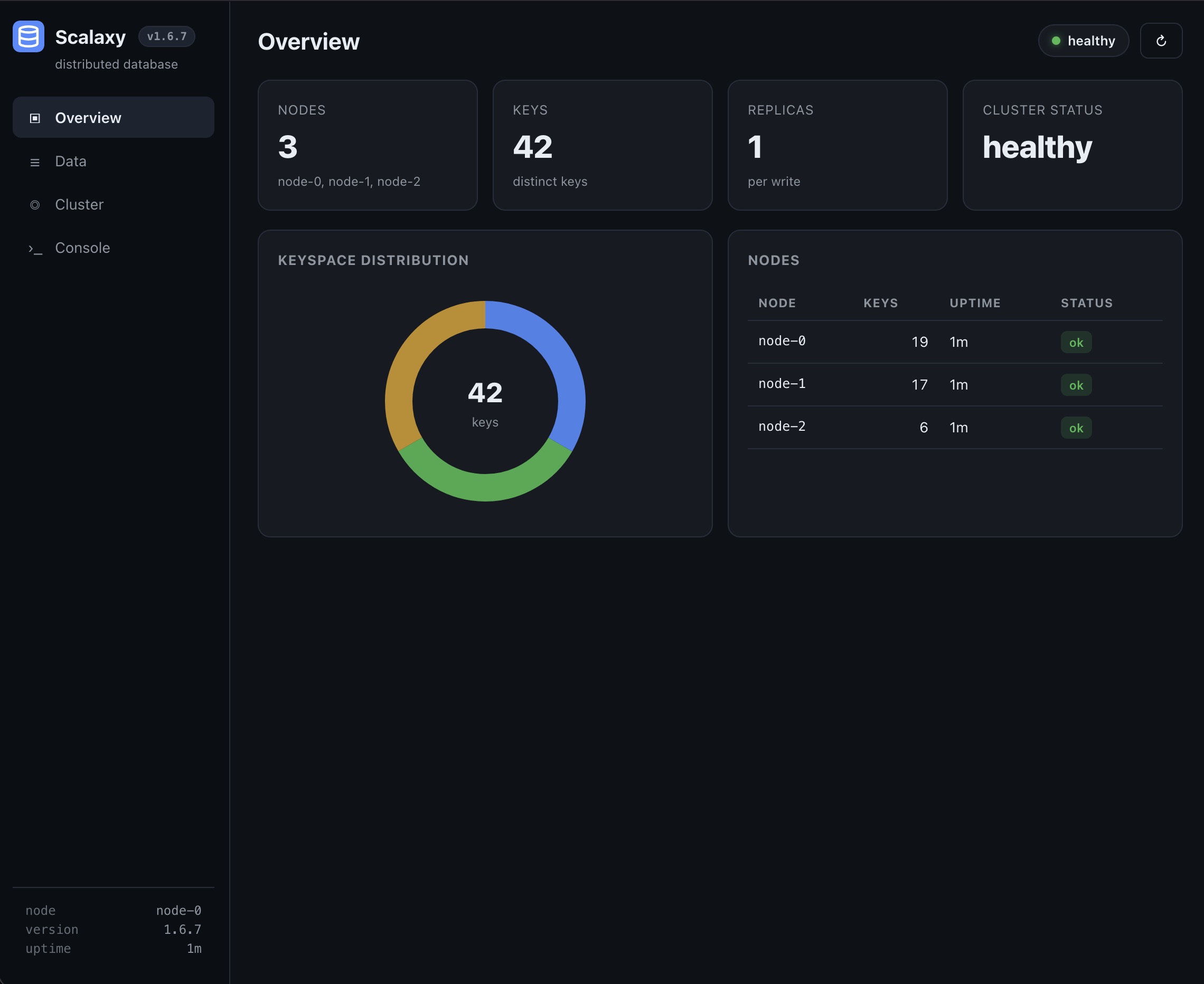
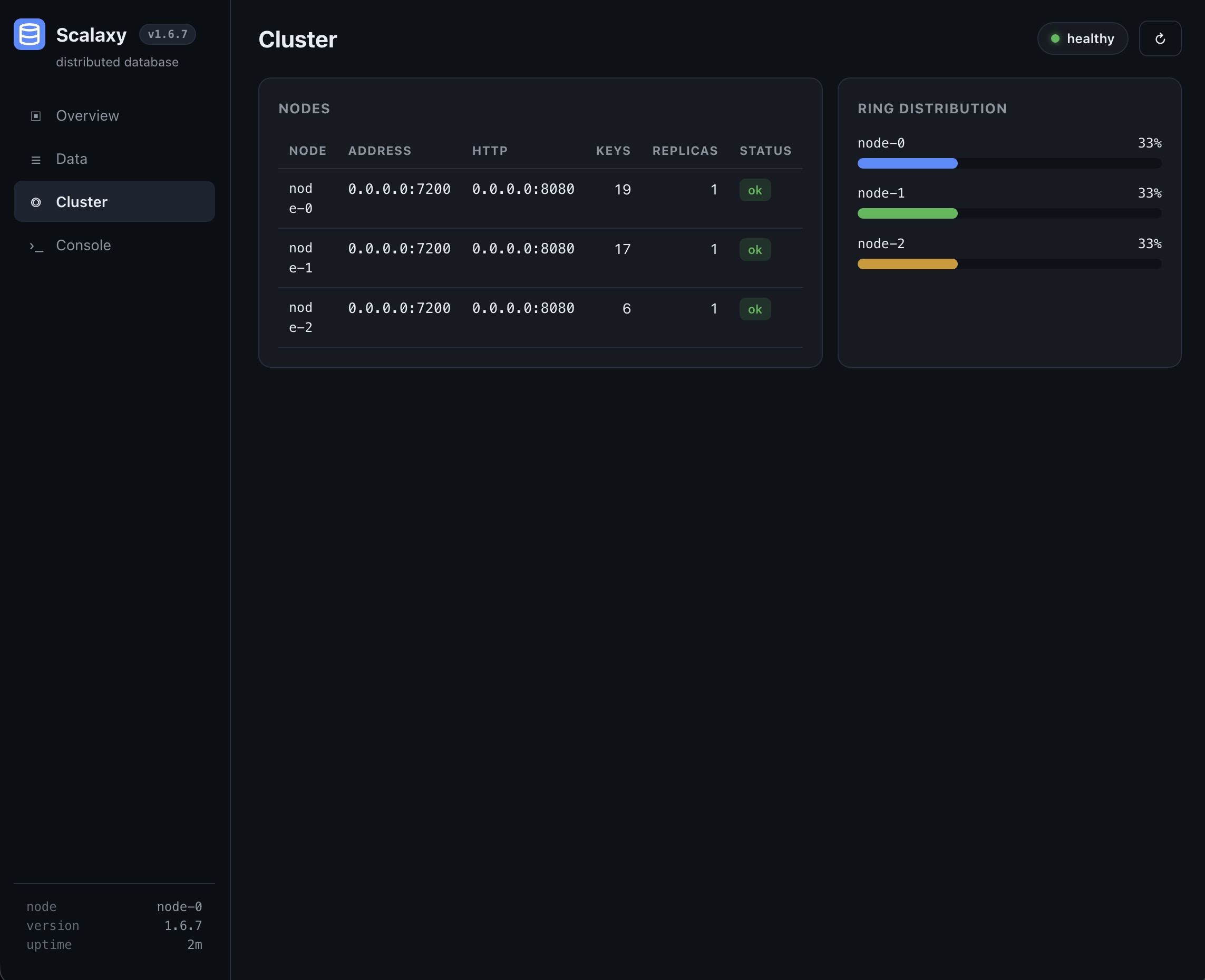
Each node serves an HTTP console with a cluster view, data browser, topology view, and command console. There is no separate frontend to deploy.
Runs in containers
The repository includes Docker, docker-compose, and Kubernetes manifests. Configure the node with environment variables.
In-tree runtime
The core is ANSI Common Lisp; JSON and HTTP are implemented in the repository. SBCL is the supported runtime.
The web console
Each node serves the dashboard and REST API on port 8080. No separate frontend process is required.
From source to a running node
01 · Install
Install SBCL 2.x, clone the repository, and run make test. The runtime has no external Lisp dependencies.
02 · Deploy
Run a single node, a Docker Compose cluster, or a Kubernetes StatefulSet. Configuration uses environment variables.
Deployment →03 · Build apps
Use the REST API, the Lisp client, or the web console. The cluster routes reads and writes for you.
REST API →Choose a deployment topology
Use the same binary for a single node, Docker Compose, or a Kubernetes StatefulSet. Set SCALAXY_PEERS and SCALAXY_REPLICATE_TO to describe the cluster.
Single node
One node, a durable log, and a web console for local development, small services, and edge devices.
Topologies →Cluster
Keys shard across N nodes. With a replica and a reachable survivor, reads fail over and acknowledged writes remain available when a node goes down.
Topologies →Kubernetes
A StatefulSet with PVCs, probes, and peer discovery over headless DNS. Change the peer list when you change the replica count.
Kubernetes →Docs for developers and maintainers
Guides cover local builds, the wire and REST APIs, Docker and Kubernetes deployment, and failure handling.