Getting started
Install SBCL, clone Scalaxy, run the tests, and start your first node.
Requirements
- SBCL 2.x: the reference implementation.
- Git, Make, and a POSIX shell for the launcher scripts.
- No external Lisp libraries are required: the JSON, HTTP, and TCP layers are implemented in-tree.
Get the code
git clone https://github.com/scalaxy/scalaxy.git
cd scalaxy
Run the test suite
make test
This runs 9,018 checks across 33 groups: consistent hashing, durable storage, protocol round-trips, replication, cluster churn, real TCP traffic, JSON, HTTP, the web API, gateway routing, status aggregation, node-failure failover, the property-graph layer, the openCypher engine (lexer, parser, AST round-trips, executor, semantics, updates, TCP/gateway/web integration, and a differential harness against a reference oracle), multi-database support, binary codec, and blob spills.
A separate conformance suite runs the openCypher TCK: all 3,898 expanded scenarios currently pass with zero failures or unsupported cases. See Cypher conformance.
Start a node
bin/scalaxy --address 127.0.0.1:7200 --http-address 127.0.0.1:8080 --data-dir ./data
You should see:
Scalaxy node <hostname>
  data:  127.0.0.1:7200
  http:  127.0.0.1:8080 (web console)
Use the web console
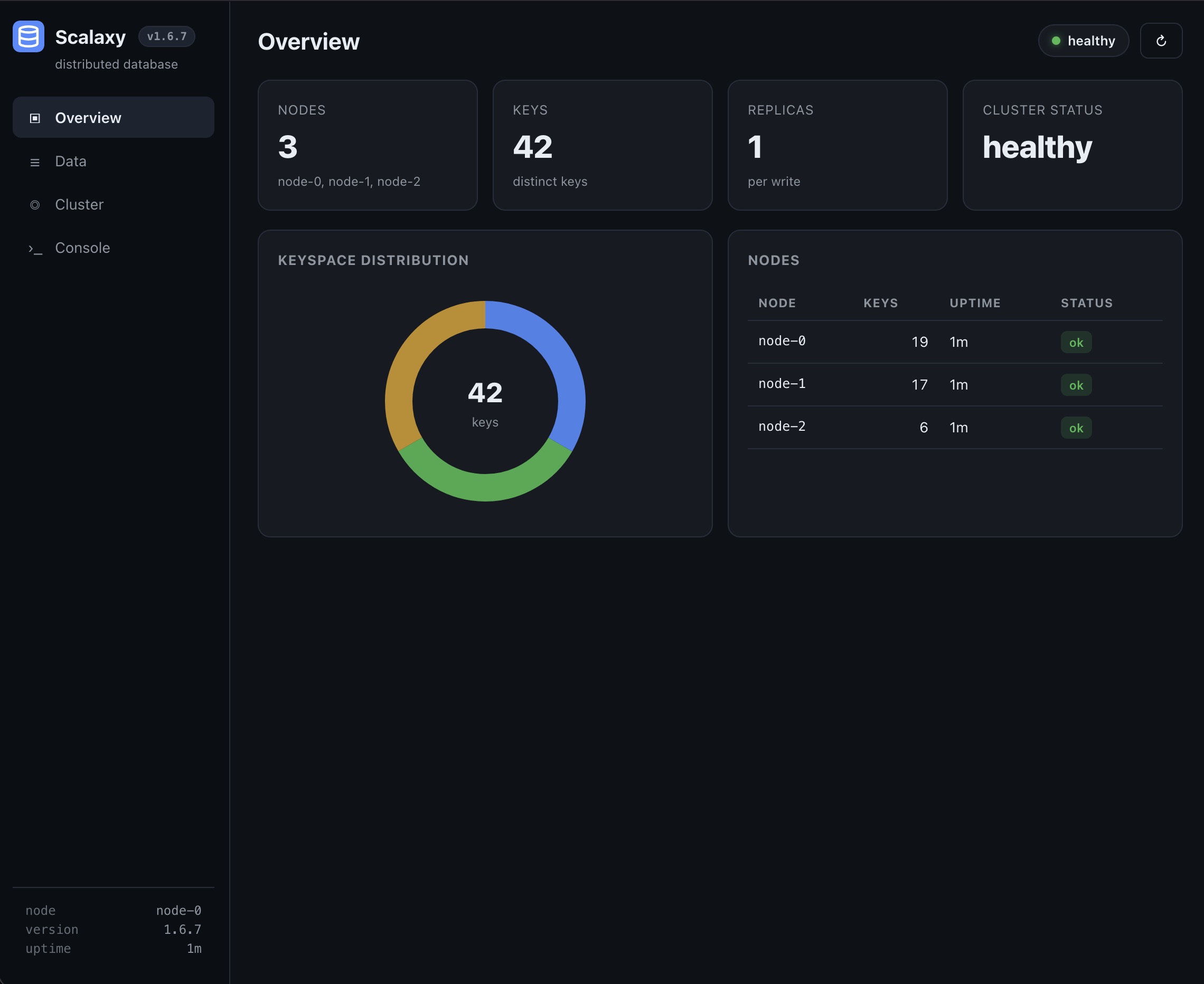
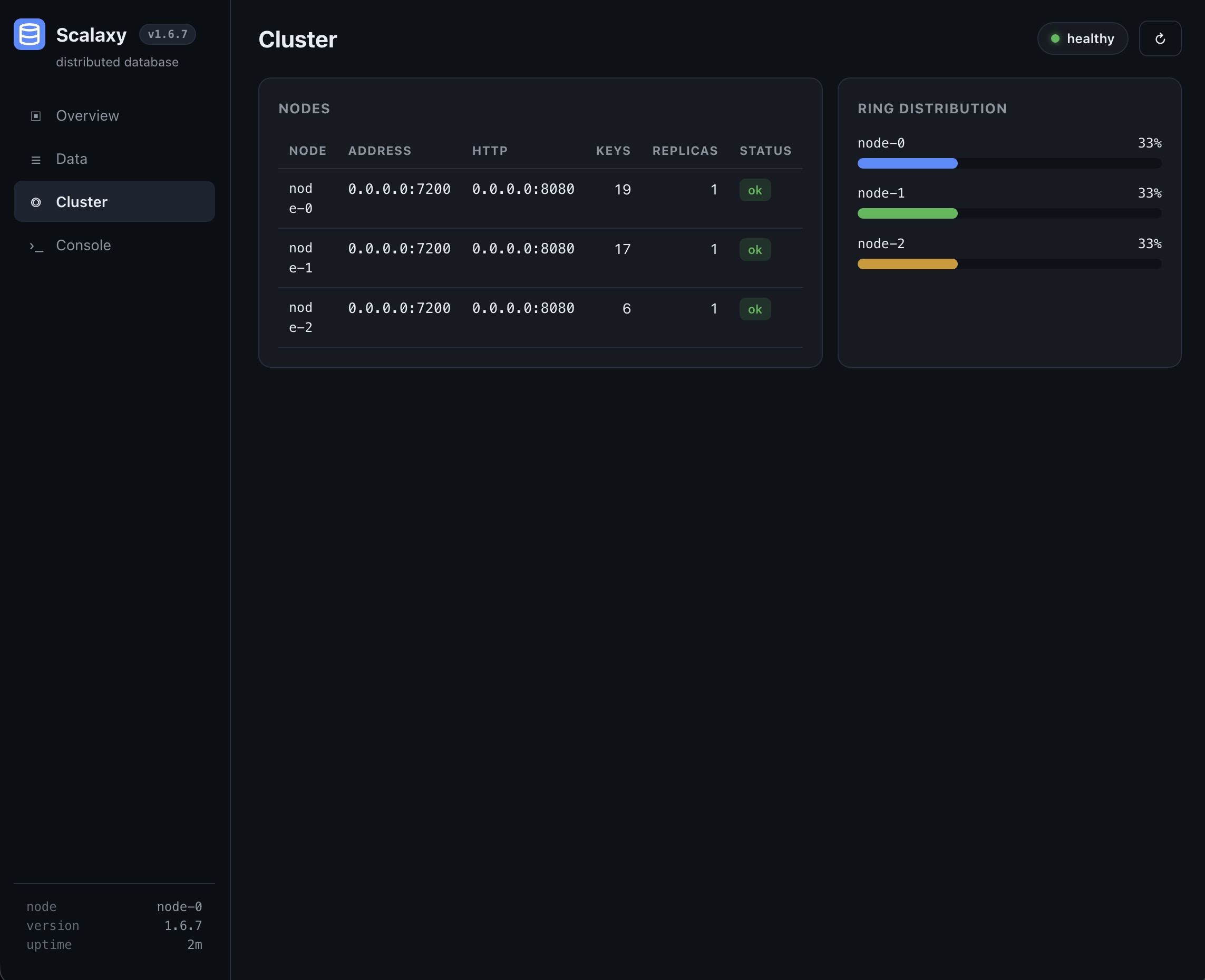
Open http://127.0.0.1:8080. The dashboard shows cluster status, keys, the ring distribution, and a command console:
Or use the REST API directly:
curl -X PUT http://127.0.0.1:8080/api/keys/greeting -d '{"value":"hello world"}'
curl http://127.0.0.1:8080/api/keys/greeting
# => {"key":"greeting","size":11,"utf8":"hello world","hex":"68656C6C6F20776F726C64"}
Query the graph
Every database also holds a property graph, queried with openCypher through the same node:
curl -X POST http://127.0.0.1:8080/api/cypher \
  -d '{"query":"CREATE (p:Person {name: \"Alice\"})-[:KNOWS]->(q:Person {name: \"Bob\"}) RETURN p.name AS from, q.name AS to"}'
# => {"columns":["from","to"],"rows":[["Alice","Bob"]],"count":1}

curl -X POST http://127.0.0.1:8080/api/cypher \
  -d '{"query":"MATCH (a:Person)-[:KNOWS]->(b:Person) RETURN a.name, b.name"}'
The language covers MATCH / OPTIONAL MATCH / WHERE / WITH /
RETURN / UNWIND / ORDER BY / SKIP / LIMIT / DISTINCT /
UNION, CREATE / MERGE / SET / REMOVE / DELETE /
DETACH DELETE, named paths, variable-length relationships, and full
aggregation. See Graph database and
Cypher.
From a Lisp REPL
(require :asdf)
(asdf:load-asd "/path/to/scalaxy/scalaxy.asd")
(asdf:load-system "scalaxy")

(defvar *db* (scalaxy:connect :host "127.0.0.1" :port 7200))
(scalaxy:put *db* "answer" "42")
(scalaxy:octets-to-string (scalaxy:get *db* "answer")) ; => "42"
Next steps
- Architecture: how the pieces fit together.
- Deployment: Docker, compose, and configuration.
- Kubernetes: run a replicated cluster on Kubernetes.